Seeds
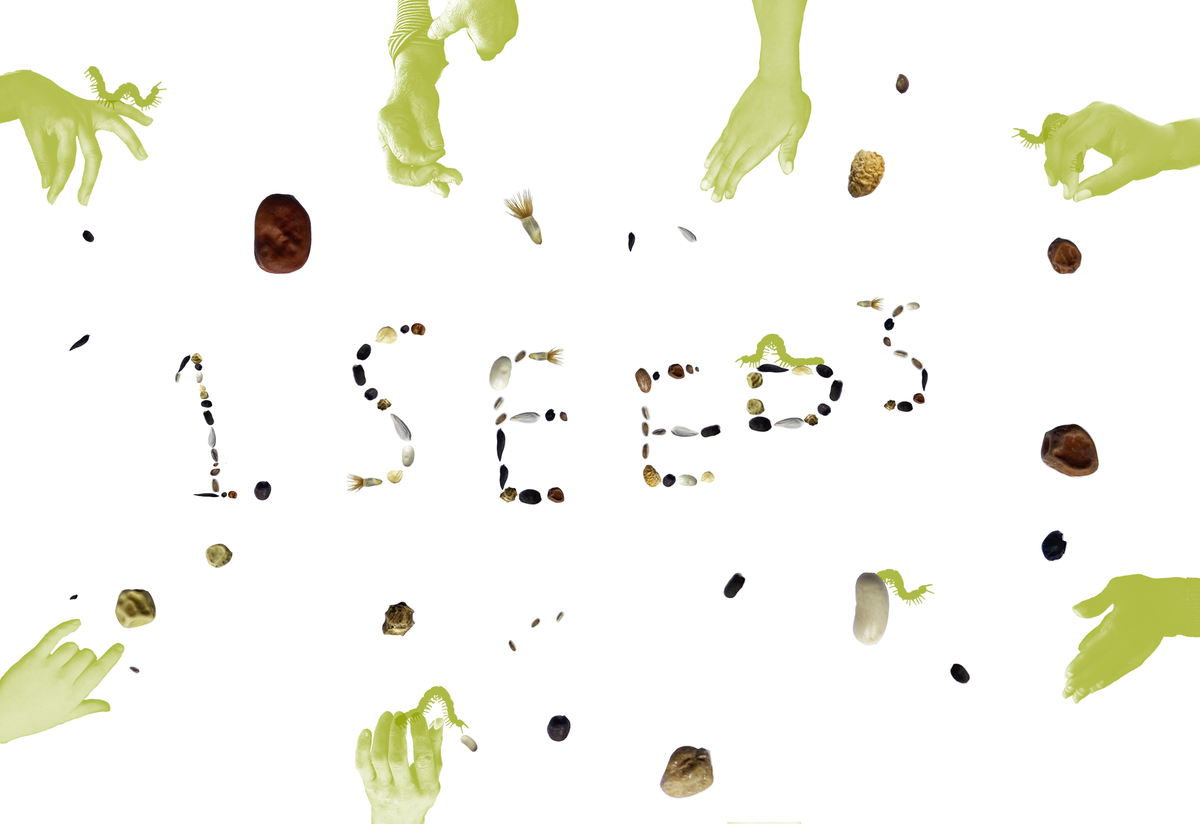
This first piece is about seeds, their stewardship, and sowing them. It is also a metaphorical sowing of seeds, for you and I to tend to, or not. There is a glossary at the bottom of this page. The definitions of the words highlighted in bold can be found there. Image descriptions are provided in alt text. At the bottom is a sneak peek of a long-term creative project I will be sharing next month.
1 - Words are Seeds
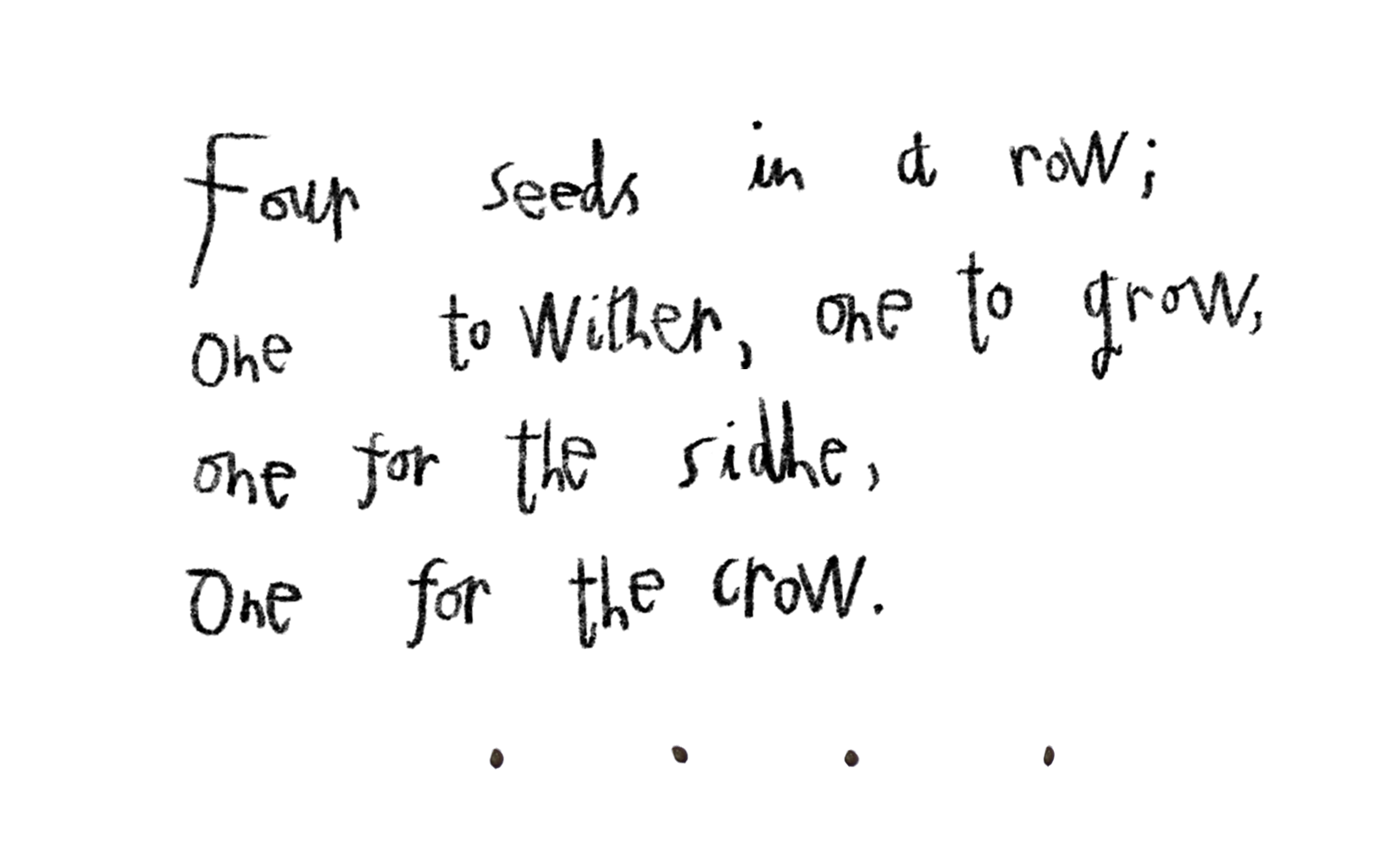
- There is an old rhyme about seeds: "Four seeds in a row; one to wither, one to grow, one for the sidhe, one for the crow." (Sidhe is the Irish word for fairies).
- I like this rhyme because it is inherently ecological and contains multitudes. It includes failure, decay, growth, fairies, stories, and crows (and more than humans more broadly) in the act of sowing a seed. And, hopefully, in the act of sowing these words.
- For the first time in my life, I have the privilege of a garden that is big enough and light enough in which to grow. It has taught me a lot, not least that the garden as a private, individually-owned, “apolitical”, and boundaried space is emergent of the systems and ideologies that have caused, and continue to cause, devastating harm to many bodies; human, more than human, bodies of land and bodies of water. This virtual compost heap is a part of my attempt to transgress and dismantle some of the literal and metaphorical garden walls that uphold these systems. To share the garden. To compost, messily and generously.
- Scientists have found that seeds process information by sending hormonal signals between clusters of specialised cells in a very similar manner to human brains.
- Or, maybe our brains send signals in a similar manner to seeds. The seeds were here first, after all.
- Not every seed that is sowed will germinate. All seeds will only choose to break their dormancy when their needs find some kind of equilibrium with the world in which their small bodies lie. To a seed, dormancy is agency. Humans are only part of the story. If we listen, we can help nurture the conditions for the seed to flourish. But we are not the only ones gardening. Seeds are gardening us too.
- Like humans, seeds also have microbiomes, microscopic communities of bacteria and fungi that live both inside and on the seed. Like humans, without these communities of care and reciprocity, seeds would be unable to grow and thrive. Some seeds, like orchid seeds, cannot germinate without the presence and care of specific fungi. 90% of plant species depend upon relationships with mycorrhizal fungi for some aspect of their flourishing. The majority of plant hormones are also produced by symbiotic bacteria that shelter inside the plant.
- By some estimates, microbes outnumber human cells in our bodies by 10 to 1. You are more microbe than human. A teaspoon of well cared for soil contains more microbes than there are humans on the planet. When you handle a seed, when you wriggle your fingers into soil, seed, soil and human microbes dance together in a microscopic disco of delight.
- I have been culturing LAB (Lactic Acid Bacteria) to water the garden. These microbes are beneficial to plants and the soil microbiome. They are the very same ones that are beneficial for humans too; found in fermented food such as yogurt and pickles. Humans, humus. We are soil too.
- I like these facts because they make me feel calm, especially as I have begun to understand myself within the politics of disability and the more I am shamed for having needs, relying on others, and not being an individual success. Maybe they will make you feel calm too.
- “Plants have so much to give us, all we have to do is ask”. Mary Siisip Geniusz, an Oshkaabewis (ceremonial apprentice) and teaching assistant to Keewaydinoquay Peschel, an Anishinaabe medicine woman from Michigan.
An animation of a fairy collecting a seed. The moon is a cut-out photo of the curds leftover after I cultured the Lactic Acid Bacteria mentioned above.
2 - Seed Matters
- Seed sovereignty is the right of every grower to “to save, use, exchange and sell their own seeds.”
- At its root, the definition of seed sovereignty seems so obvious to be almost obsolete. Until a few generations ago, it was. For each crop grown, from arable field to allotment, the grower would save some of the seed to sow next year or to swap with another grower. As such, the genetic diversity of seed across the earth was as varied and intricate as the cultures that grew them. A variety of wheat saved and sown year upon year by generation upon generation of farmers on the South Downs around Brighton (where I live), would have grown and adapted specifically to the local conditions and hands that grew them. The story of the symbiosis between people, land and plant would have been written into its DNA. It would be genetically different to a variety grown in Limerick, Ireland. As would a variety of grain grown by a farmer in Jenin, Palestine. Or Gujarat, India. Each would tell an ancient story of symbiosis.
- These local, heritage varieties are known as landraces. Like other botanical terms, this word has a distinctly fascistic undertone to it. This has not been lost on me, nor on fascists, which we will explore together in further detail soon.
- The concept of seed “ownership”, a seed market as opposed to a seed commons, is relatively new. The first seed was patented in 1931.
- Today, 60% of global seed is owned by just 4 companies. BASF, Bayer/Monsanto, ChemChina-Syngenta, and Corteva Agriscience currently own the rights to over two thirds of the world’s seed and pesticide sales.
- Most of this seed has been specifically bred to produce that which capitalism prides most: the largest possible profit for the cheapest possible production. Uniformity over diversity. Profit over planetary flourishing.
- Nowadays, the chances are fairly high that the grain grown in Sussex is genetically identical to the grain grown in Limerick, or Gujarat. The farmers cannot save this seed because it is (intentionally) infertile. In some cases, saving this seed is illegal because it is owned by the companies (cropyright?). So each year, farmers must buy new seeds. Being infertile and genetically identical, the seeds are unable to adapt to the intricate variations in local conditions. One seed does not fit all. Instead, they require vast amounts of agricultural inputs; pesticides, herbicides, fungicides, and artificial fertilisers. Farmers must buy these too. Guess who owns most of these inputs?
- According to the UN, only 25% of the aforementioned crop diversity- the rich tapestry of interwoven plant-human-soil relationships- survive. The millenia of stories written into the DNA of both people and plants, the sacred covenants of care and reciprocity between seed, soil and sower, have been either severed or erased.
- Today, we* eat only 200 species of the 300,000 or so species of edible plants we co-habit the Earth with. In supermarkets, you will find probably only 40 or so of these, and most of them will be genetically identical to those being sold in supermarkets across the country.
*I am writing from the UK, though this is increasingly the case in neoliberal capitalist societies.
- Like humans, seeds travel. Some, like dandelions, are carried for hundreds of miles by the whispers of winds. Some, like apple seeds, travelled in the vessel of human guts. In 1929, a Russian scientist called Nikolai Vavilov found that domesticated apples (Malus domesticus) across the world could be traced to a single wild relative found in the folds of the Tian Shan Mountains in Kazakhstan, Malus sylvestri. Over thousands of years of human-apple gastronomic imaginings, apple cultivation spread westward resulting in the thousands of varieties found today.
- Vavilov set up the world’s very first seed bank in Russia, with the intention of preventing mass starvation having witnessed multiple devastating famines growing up in pre-revolutionary Russia. One of the first Western scientists to recognise the importance of seed genetic diversity, he dedicated his life to identifying and collecting the wild relatives of domesticated crops across the world (following the blood-stained inroads made by colonising powers). Despite his work, he fell foul of Stalin, who favoured another scientist Lysenko. Lysenko’s pseudo-scientific work fit much more neatly into the Stalinist vision of rapid growth and also set the stage for the virulent development of eugenics. As they rose to power, the Third Reich took advantage of both men’s work; eugenics became a key tenet of Nazism and the acquisition of the Vavilov’s seed bank was a key motivator for the Nazi’s invasion of Leningrad in 1941. Vavilov was arrested by the NKVD in 1940, himself accused of undermining socialist reforms and promoting the “bourgeois pseudoscience of genetics” (despite his work being recognised and substantiated by geneticists across the world) and died of starvation in a Soviet prison camp in 1943.
- Hitler, recognising the power of controlling the world’s food supply in securing world domination and the importance of Vavilov’s seed bank to these ends, sent a special SS task force to secure the seed bank during the siege of Leningrad. Vavilov’s colleagues barricaded themselves inside, and as the Nazi’s ruthlessly starved 800,000 Leningrad citizens to death over the 872 day siege, they themselves died of starvation having made an agonising choice; to protect the seeds for the future, rather than relinquish them to fascism or feed themselves and their brothers and sisters on the streets of Leningrad. Read more here.
- Ok, back to apples. There are now around 7,500 apple varieties across the world, with over 2,500 heritage varieties in the UK. Count how many of these varieties you see in a supermarket, and how many have a little trademark… Again, the genetic diversity of apples has been eroded by neoliberal market forces for the aforementioned reasons. Reflecting their rich and diverse cultivation in the UK and globally, there is also a rich and diverse tradition of apple-related folklore that predates the biblical original sin. Wassailing is one of my favourites.
- Despite their testament to the importance of diversity, heritage (also called heirloom) varieties and landraces have proved fertile soil for fascism. The Nazis, for example, were very keen on the promotion of “native” German crops and herbs- grown strictly organically to produce the healthiest Aryan souls and soils. (Ironically, modern herbicides and pesticides were developed from chemicals deployed by the Nazis in gas chambers). A more recent example from closer to home:
The British National Party (BNP) ran their Land and People campaign in the early 2000s urging,
‘Readers with larger gardens to plant an apple tree, or three, not just for the benefit of local wildlife, but as an assured means of establishing a supply of fresh fruit for the table. Furthermore, we would suggest hunting around for the many less well known English apple varieties, thereby helping to preserve a part of our heritage into the bargain!’
- This campaign seems almost sophisticated seeing as Reform UK’s “serious plan” to “improve food security” goes no further than promising “70% of food to be grown in the UK”. Presumably they haven’t done much further reading into seed sovereignty and crop diversity, but one can only guess what the resulting policy would be in their plight “to secure Britain’s future as a free, proud and independent sovereign nation.”
- So, one can see how the idea of heritage/heirloom crops and seed sovereignty can be easily co-opted by far right rhetoric despite the ironic historical context we will look at next.
3 - Seeds of Colonialism
- Plants and planting have long been used as tools of colonialism, imperialism, and empire. European “modernity” was built upon the exploitation and cultivation of plants- cotton, tea, tobacco, sugar, to name a few. In her book Plants and Empire, Colonial Bioprospecting in the Atlantic World, Londa Schiebinger writes:
“[B]otanists at this time were “agents of empire”: their inventories, classifications, and transplantations were the van- guard and in some cases the “instruments” of European order[...they] specialized in cultivating those plants crucial for European colonizing efforts in tropical climates.”
- Following 1492, maize (which was cultivated by Indigenous communities of Latin America for thousands of years), was extracted, bred and transplanted to Africa by Europeans. The rapidity and relative ease of maize cultivation was used to increase populations across Africa and thus satiate the demand for enslaved people to drive the engines of empire. Despite (or perhaps because of) its soil and ecosystem-destroying potential when grown industrially, production of maize in African countries continues to increase, totalling 95 million metric tons in 2023-4. In March 2025, Bayer (one of the companies we met earlier) announced it was opening a 30 million euro maize seed production facility in Zambia, promising “food security” for millions of small-scale farmers.
- The Zambian Alliance for Agroecology and Biodiversity writes: “In Zambia, many farmers uphold agroecological principles rooted in traditional knowledge passed down through generations. These practices harmonise with natural systems, cultural traditions, and our community's needs. Multinational corporations wield influence, shaping global and local laws to monopolise the food system, prioritising profit over farmers and consumers.”.
- In an ugly but unsurprising twist, many Indigenous African crops that were deemed backward by European colonists are now being sold today in Western countries as “superfoods”. I recommend this video essay to learn more.
- The importance of plant-human relationships in resisting colonialism, and the power of seed sovereignty in growing and sustaining community, kinship, culture and resilience can be seen in its intentional targeting by settler-colonial and autocratic regimes. Most recently, on 31st July 2025, Israeli forces bulldozed the Palestinian Union of Agricultural Work Committees' seed multiplication facilities in the illegally occupied West Bank. Within minutes, generations of interwoven plant-people knowledge and relationships were destroyed. This is simply the latest act of eco-cultural violence by Israeli forces in Palestine. Seed, food and land sovereignty have been intentionally and strategically destroyed across historic Palestine and the occupied territories. Palestinians continue to sow seeds of resistance in the face of genocide and unspeakable violence. Here’s another film I recommend, and read to the end to find out how to support our Palestinian siblings and seeds.
- Exeter Seed Bank is organising a fundraiser for the recently destroyed seed multiplication facility. Please donate here: https://exeter-seed-bank.sumupstore.com/
- Seed diversity is pivotal to cultivating just* and resilient food systems as the 1% continue to hurtle us along the path of ecological and planetary collapse. This is now understood and advocated for by the Very Important Scientific Institutions that propagated the very “agents of empire” that set us on this path in the first place.
- *The “just” component is still a work-in-progress; it is hard work dismantling 500 years of white supremacy, after all(!).
- To address the very real spectre of food system collapse, ‘seed banks’ have been set up across the West, including the Millennium Seed Bank by the Royal Botanic Gardens Kew and the Svalbard Global Seed Vault which imitates the Arctic squirrel and buries seeds in permafrost for safekeeping.
- The Millennium Seed Bank is a particularly poignant example of colonial “rebranding”. S. Xan Chacko has written an excellent article composting the ‘depoliticized valence of “biodiversity conservation”’. They write,
[Through] the practices of extracting seeds from where they grow, moving them across the globe, rendering them legible through subjective laboratory practices, and putting them in freezers[...] scientists create new identities, meaning, and value for seeds through inscriptions of data and experimental practice. [Uncovering] these stories…demonstrate[s] how colonialism endures as a system that structures the valuation of life. My research shows how concepts such as biodiversity, ecosystem services, food security, and extinction are evoked in an era of neoliberalism to continue the colonial practices of extraction, alienation, and re-inscription.
- Note the difference in language here; seed BANK/seed LIBRARY.
- For an exquisitely sensitive interrogation of some of these juxtapositions, I recommend the film Wild Relatives by Jumana Manna.
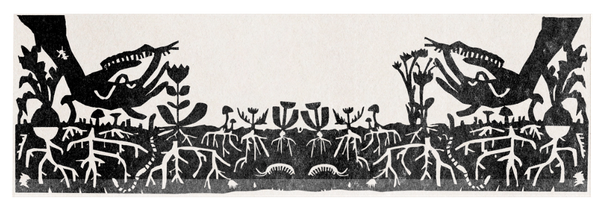
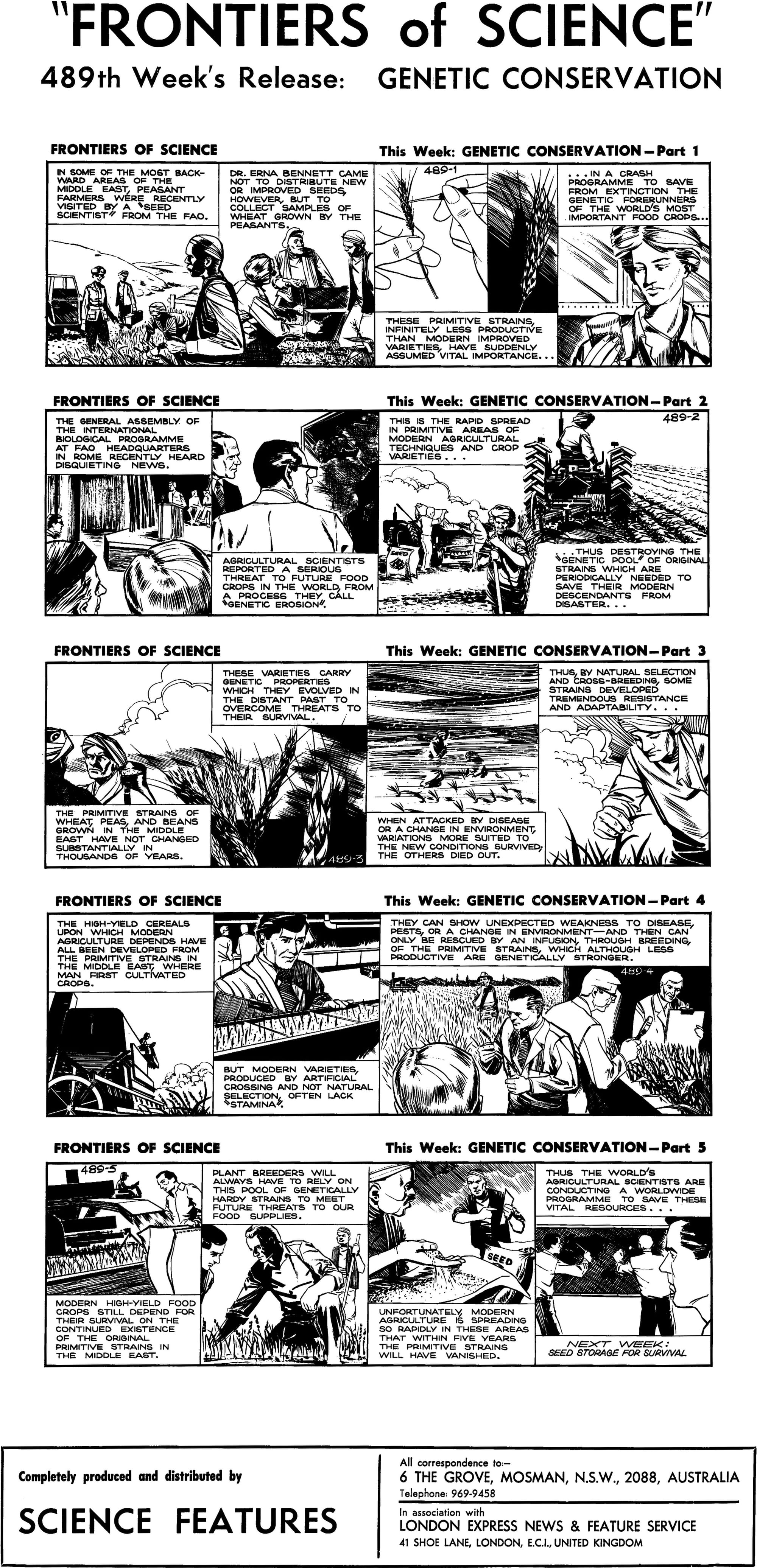
- Or, for a much less sensitive explanation, read the cartoon image below.
- When I last visited the Millennium Seed Bank at Kew’s site in Wakehurst, they had a display about Himalayan Balsam, a now much maligned and enthusiastic self-seeder that is considered an invasive species (conservation groups regularly hold balsam-bashing parties). They neglected to include the fact that Himalayan Balsam was first introduced to the UK in 1839 by Dr. Royle of Kew Gardens (Day, 2015) as an ornamental garden plant, and was excitedly studied by some of the scientific giants of 19th century botany.
- They even named us, the children and grandchildren of the bodies that did the dirty work of empire after seeds: The etymology of diaspora is “two (dia) seeds(spore/a)”. The coloniality of botany goes both ways; native, non-native, invasive, naturalised are all botanical terms that are straight out of the fascist rule-book. Or vice versa.
4 - Seeds of Resistance
- Oppressed and marginalised communities across the globe continue to nurture that which they have always done; the sacred reciprocity between communities, seeds, and soil. Vivien Sansour set up the Palestinian Heirloom Seed Library (مكتبه البذور البلدية الفلسطينية) in 2014;
“Heirlooms, which have been carefully selected by our ancestors throughout thousands of years of research and imagination, form one of the last strongholds of resistance to the privatization of our life source: the seed. These seeds carry the DNA of our survival against a violent background that is seen across the hills and valleys through settlement and chemical input expansions.
Heirloom seeds also tell us stories, connect us to our ancestral roots, remind us of meals our families once made at special times of the year. The Palestine Heirloom Seed Library (PHSL) is an attempt to recover these ancient seeds and their stories and put them back into people’s hands.”
Further wriggling suggestions here and here.
- How do we resist the violation of seed sovereignty and stand in solidarity with indigenous and small-scale growers across the world, while also refusing to allow far-right nationalism to co-opt and exploit indigeneity to push a fascist agenda? How do we muddy the colonial lines between native and non-native, invasive and naturalised, while honouring the shifting needs of the soils that nurture us?
- Seeds are not inert or static. They are verbs; past, present, and future tense all at once; the etymology of seed comes from the Proto-Indo-European root verb sē- “to sow”. Rowen White, a Seed Keeper/farmer from the Mohawk community of Akwesasne, describes seeds as “intimate immensities”. They contain multitudes, one and many simultaneously.
- Some seeds germinate, grow, flower, and set seed in a matter of weeks. As we’ve seen, some have been bred to do this in a way that forcibly impedes kinship and communion with people, place, and the polyphony of ecological lifeworlds.
- Others, like acorns, take many lifetimes, and touch many, many lives in the process. It is in part this slowness that means oak trees support over 2,300 species, with 320 found only on oaks and 229 found almost only on oaks. Multiply that by the numbers of acorns borne by an oak tree in its lifetime (10 million).
- The work of Vietnamese Zen Buddhist monk, Thich Nhat Hanh, introduced me to the Buddhist concept of ripening. The seeds that we sow, literal and metaphorical, may never bear fruit and seeds in our lifetimes. Nor in our children’s lifetimes. But if we sow only to reap the fruit for ourselves, we will never establish the deep-rooted connection and infinitely intricate webs of life needed to bring about radical and transformative change. Just like the core teaching of the Haudenosaunee nations of Turtle Island (USA), our lifetimes must include the lifetimes of the 7 generations that came before us and the 7 generations that will come after.
- Heirloom varieties require more care and time than the mass-produced, genetically modified or hybrid seeds. As an autistic/disabled/queer mixed race human-shaped seed, I feel a deep affinity with them. Like me, they are too needy, too sensitive, too wonky, too slow, too much of a liability for neoliberal capitalist society. They tell quiet, complex stories, without heroes in lab coats or big shiny tractors or record-breaking yields; just quiet, plodding, care-taking and earth-tending, season after season, generation after generation.
- I often feel hopeless. The world is a dark place. I was speaking with a good friend recently, and he was expressing frustration with the sentiment thrown around with increasing frequency these days; we’re fucked, we’ve lost the fight. Which implies resistance is futile. Moreover, he was expressing frustration that for the most part, the behaviour of those people told otherwise; if we’re fucked, why bother with anything? And often, the people saying this are in a considerably less fucked position than many.
- Hope is often talked about as something you must have. I see it as something you must do. Mariame Kaba talks of hope as a discipline. A practice. A verb. (Here is an interesting critique of Mariame Kaba's idea of hope.)
- I could gather all the hope or pessimism in the world, all the theories of change, and possible futures, all the predictions and political manifestos and policy changes, yell it at the garden and nothing would grow. Indeed, I might conclude that there is no point. That resistance is futile.
- Or I could sow a seed. Or four. Hope is a verb. So is a seed. An embodiment of the future. To sow a seed begets hope. A seed is a commitment to the future, however that future may be. The seeds we sow might be metaphorical. We might not see the flowers or fruit borne by that seed in our lifetimes. It might wither (and feed those soil microbes). It might grow. It might mollify some fairies. Or it might feed a crow.
- Resistance is always fertile.
‘Soil is a metaphor of decentralized and deep democracy… Consumer democracy is a pseudo-democracy associated with economic dictatorship; it desertifies the soil of real democracy. Authentic democracy, like plants, grows from the ground up. It is fertilized by people’s participation.’ Vandana Shiva, Soil Not Oil: Environmental Justice in an Age of Climate Crisis, South End Press, Brooklyn and Boston, Massachusetts, 2008, p 7.

The best way you can show up for seeds and seed sovereignty is to join a local seed library/seed-saving network. Access to land and growing space is a privilege that should be a right, which we will wriggle into in a later piece. Nevertheless, even if you only have a window sill, there are many possibilities for growing and saving seed. Alternatively, share this with someone who does have a growing space. Or do some guerrilla gardening and make an open-source seed bomb.
A recipe for a seed bomb:
Seed bombs are a way of distributing and sowing seeds when access to growing space is limited (by political/social conditions). They are often used in guerilla gardening, and can be thrown over fences/walls. They are sort of like a symbiosis between plants and people, with people helping plants to spread their seeds, just like pollinators help plants spread their pollen and reproduce.
- Mix a handful/cup of seeds* with 1 handful/cup of compost or soil and either 5 cups of shredded brown paper/cardboard soaked in water, or air dry clay. Mix them together in a large bowl with enough rainwater (the chlorine in tapwater is not friendly to seed/soil microbes) to make a dough-like consistency.
- Roll your seed mixture into balls about the size of a large conker or a golf ball. Let them dry in the sun. Keep them in your pocket/bag and as you go about your wanderings and see a bare patch of soil or a monocultural lawn, lob ‘em and whisper a spell of sweet germination to the soil spirits and the pollinators.
*use open pollinated/open source seed, from the companies/seed libraries listed below or from a neighbour or an auntie or a wildflower (ask the wildflower's permission first) or email me and I will post you some seeds I have saved. It would be a pleasure and a gift of thanks for reading this far!! therosaartist@gmail.com :)
Local seed libraries:
Seeds of Hope Seed Library (Bradford)
Incredible Edible Seed Library (Lllanelli)
Hwb Hadau Cymru/Wales Seed Hub
Stroud Community Seed Guardians
Malvern Green Space Community Seed Bank
More here: https://www.seedsovereignty.info/near-me/
National UK seed library: https://www.gardenorganic.org.uk/what-we-do/hsl
Resources for saving/growing seed:
A Seed Saving Guide for Gardeners and Farmers
Real Seeds guide to seed saving for beginners
Companies that sell open-pollinated/open-source seed:
Real Seeds- this awesome company also sell a Low-Waged/Unwaged Gardeners Seed Pack here
Hwb Hadau Cymru/Wales Seed Hub
Support small-scale growers, marginalised growers, and peasant farmers:
Land in Our Names - A Black and People of Colour-led grassroots collective whose work addresses the inequalities in access to land and food, and reimagines land stewardship towards land reparations, and climate and racial justice.
The Landworkers Alliance - A UK-based grassroots union of farmers, growers, foresters and land-based workers, working toward a more sustainable and just system of land stewardship and food sovereignty. The UK branch of La Via Campesina.
La Via Campesina - La Via Campesina, founded in 1993, is an international movement bringing together millions of peasants, landless workers, indigenous people, pastoralists, fishers, migrant farmworkers, small and medium-size farmers, rural women, and peasant youth from around the world. Built on a solid sense of unity and solidarity, it defends peasant agriculture for food sovereignty.
https://www.instagram.com/apnorg/
Books/Podcasts/Further Wriggling:
Shado Mag's explainer on Seed Sovereignty.
Resources from the Gaia Foundation's Seed Sovereignty Programme, including some excellent films.
Queer Botany for Seed Savers Webinar by Christian Keeve and Emily-May Armstrong.
Future Ecologies podcast S4E1: Forest / Garden
Lifeworlds Podcast Episode 20: Seeds: The Life Keepers — with Milka Chepkorir Kuto
The Fire These Times podcast Episode 177: Leila Al Shami joined by Serge from Buzuruna Juzuruna, an agro-ecological farm and heirloom seed producer in the Bekka Valley working on food autonomy, and Abir from Hostel Beirut, a worker owned cooperative in the heart of the Lebanese capital committed to social and economic justice for all.
The Land in Our Bones: Plantcestral Herbalism and Healing Cultures from Syria to the Sinai by Layla K. Feghali (book)
Feel the Grass Grow: Ecologies of Slow Peace in Colombia by Angela Jill Lederach (book)
The Nutmeg's Curse by Amitav Ghosh (book)
Glossary
Mycorrhizal fungi - Soil dwelling, tiny, threadlike fungi that exchange nutrients and minerals with plants, creating an underground network through which plants and trees can also communicate with each other.
Symbiotic - used to describe a relationship between two different beings that supports and benefits both of them.
Humus - a substance made from decomposed matter that binds all the particles that make up the soil together; a bit like soil glue.
Heritage/heirloom variety - a traditional, often very old, variety of plant that has been grown by generation after generation often in a specific place.
Fascism - a political ideology that is characterised by rulers who use force and violence to control citizens. It often favours one identity/ethnic group over others, and uses force, violence, and authority to silence those who disagree or do not cooperate. A fascist is someone who believes in this ideology.
The Commons - a system of ownership where no individual person owns or controls things (like land, seeds, food, or technology), but everyone in the community shares and takes care of them together.
Capitalism - a way of controlling money and wealth that prioritises individual ownership, competition and making as much money as possible, at the expense of collective ownership and wellbeing, even if that causes deep inequality and injustice.
Infertile - for plants this means they cannot produce seeds that will grow into new, healthy plants.
Neoliberalism - A way of running a society that favours capitalism and individual interest over state ownership and government control. For example, instead of hospitals and healthcare being free to access because everyone pays a little bit to the government who then runs the hospitals, hospitals and healthcare are owned by lots of different companies that are allowed to charge lots of money for accessing them. This means people with less money cannot afford healthcare and richer people are better taken care of.
Eugenics - a false and harmful set of beliefs and practices that aims to prove that some people are better than others because of their genetics, and only those people should be allowed to have children.
NKVD - The secret police force that operated under the dictator Josef Stalin in the Soviet Union.
SS - Schutzstaffel; the Nazi party’s secret police/soldiers.
Organically grown - Growing plants without using substances to kill weeds, insects, or fungi (herbicides, pesticides, fungicides), artificial fertilisers, or any other chemicals/synthetic inputs.
Food security - having enough food to feed everyone. This is different to food sovereignty, which emphasises the importance of how food security is achieved. Food Sovereignty is the right of peoples to healthy and culturally appropriate food produced through ecologically sound and sustainable methods, and their right to define their own food and agriculture systems. It puts the aspirations and needs of those who produce, distribute and consume food at the heart of food systems and policies rather than the demands of markets and corporations. (Definition from La Via Campesina).
Colonialism - when one country or group of people (the coloniser) invades and takes control of another country or group of people (the colony), using force and violence to maintain control and exploit that country/group of people for its own gain.
Imperialism - The practice of one country using its power to dominate other countries, sometimes through colonialism, but also through economic policies, military power and the spread of cultural/political beliefs.
Industrial growing/industrial agriculture - a way of growing crops and farming livestock on a huge scale that prioritises maximising profit, efficiency and yields. It is characterised by monocultures (growing a single crop over a large area), and heavy reliance on synthetic fertilizers, pesticides, machinery, and genetic technology and is dominated by multinational corporations.
Agroecology - The application of ecological principles and processes to farming in which the flourishing of all life, from soil bacteria to humans, is important. It emphasises the relationship between social and ecological justice.
Biodiversity - the variation and diversity of all living things and ways of being, from genetics to species and ecosystems.
Indigenous - this word is used for both humans and more-than-humans (plants, animals, microorganisms and fungi). For the latter it means the plants, animals, fungi and microorganisms that have evolved to live in that place over many millions of years.
Indigenous people - The people who originated in relationship to a particular place and maintain a connection to, and stewardship of, its earth-based customs, pre-colonial languages, cultures, and concepts of self, relationships to land and water, ancestral practices and rituals, place-based cosmologies and identities, and mutual recognition within community kinships and ecologies.**
**Adapted from Layla K. Feghali
Invasive - a botanical term used to describe a species that is not indigenous to a place and has not found a balanced relationship within the ecosystems that already exist there
Naturalised - a botanical term used to describe a species that is not indigenous to a place and has found a balanced relationship within the ecosystems that already exist there
Diaspora - A diaspora is a population/community that is scattered across regions which are separate from its geographic place of origin.
Nationalism - a political ideology that emphasises national identity and loyalty to that identity, often over and above other nations/identities.
Lifeworld - a word that acknowledges the experiences of living in the world unique to a particular being.
Guerrilla gardening - Guerrilla gardening is a grassroots movement where individuals or groups cultivate plants in neglected, public, or private spaces. It’s an act of environmental activism, aiming to reclaim unused land for the community, by growing vegetables, herbs and flowers to make spaces better for humans and other species.**
**adapted from Earthed.co
Open source seed - Seed of a plant variety the genetics of which cannot be restricted by patents or other intellectual property rights and therefore is free for any one to grow, save, and share for future generations.**
**adapted from Real Seeds
Open-pollinated - plants that have been pollinated naturally by insects, wind, or animals and therefore have the agency to reproduce generation after generation increasing genetic diversity (as opposed to this natural cycle being manipulated/impeded by human intervention). These seeds will grow a variety that will breed ‘true to type’ from one generation to the next. The seeds produced will carry their parents’ genetic material and plants grown from them will bear their characteristics.**
**adapted from Garden Organic
F1 Hybrid seed- F1 hybrids are produced by humans artificially crossing two genetically stable plant varieties, resulting in a uniform next generation with good vigour and yield. However, this next generation is sterile and therefore cannot reproduce, interrupting natural cycles and the genetic diversity of future generations. This means growers must buy new seeds each year and plants cannot adapt to conditions year upon year.**
**adapted from the RHS
If you've made it this far, thank you. It means a lot. I'd love to hear what you think, how you're composting, and any feedback. You can leave a comment below or email me: therosaartist@gmail.com.
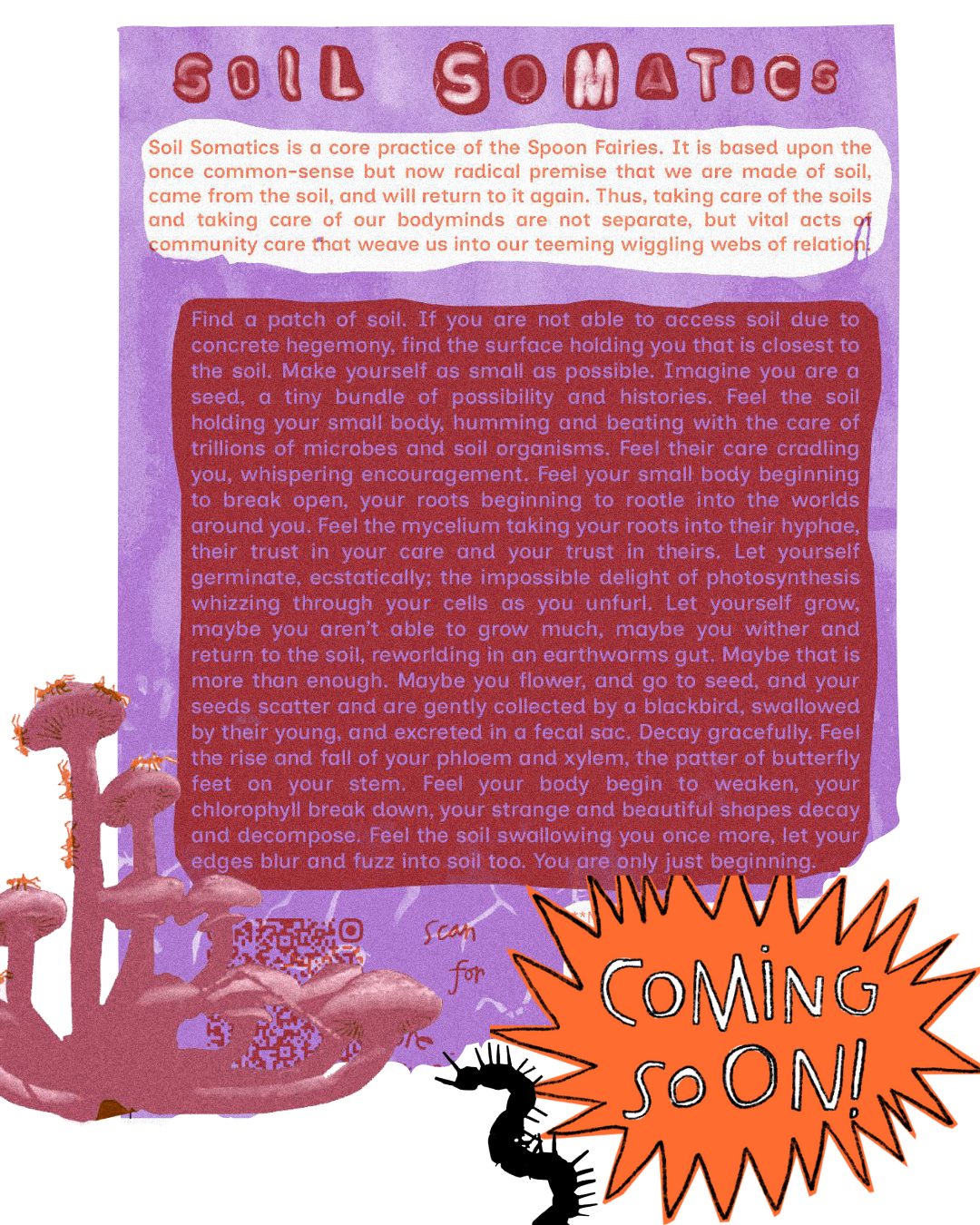
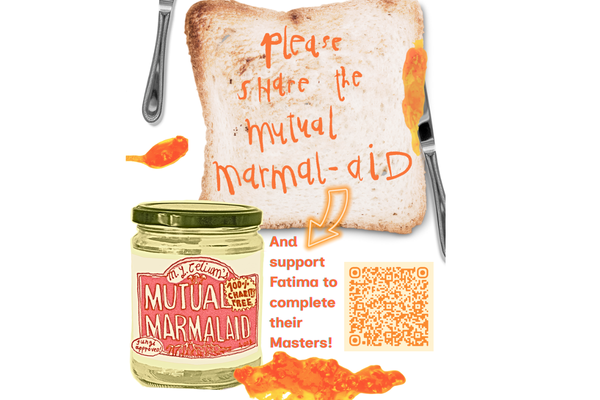
Below you can find a sneak peak of a project called "The Spoon Fairies" that I am sharing next month. This is a risograph printed zine that will be available to buy/borrow.